Source note: This article is adapted from a live talk by Wey Gu, founder of Nowledge Labs, at AGIBar 2026. The original Chinese slide deck is available at siwei.io/talks/agibar-2026. Slide illustrations in this English edition are translated renderings of the original slides, preserving the layout, diagrams, and factual content. The two race photographs that open the deck are not reproduced here; they are in the original deck.
1. Starting with the Sub-Two-Hour Marathon: A Metaphor for Open Source
On October 12, 2019, in Vienna, Eliud Kipchoge finished the INEOS 1:59 Challenge in 1:59:40, the first time in history a human ran a marathon in under two hours.
If you look at the moment he crossed the finish line, the runners blurred out in the background were cheering for him too. For all of humanity, it was a remarkable milestone. And when you watch how the whole run unfolded, you see immediately that he did not achieve it alone: 41 pacemakers ran alongside him, forming a V-shaped shield like migrating geese to cut the wind, rotating in shifts to maintain ideal aerodynamic conditions.
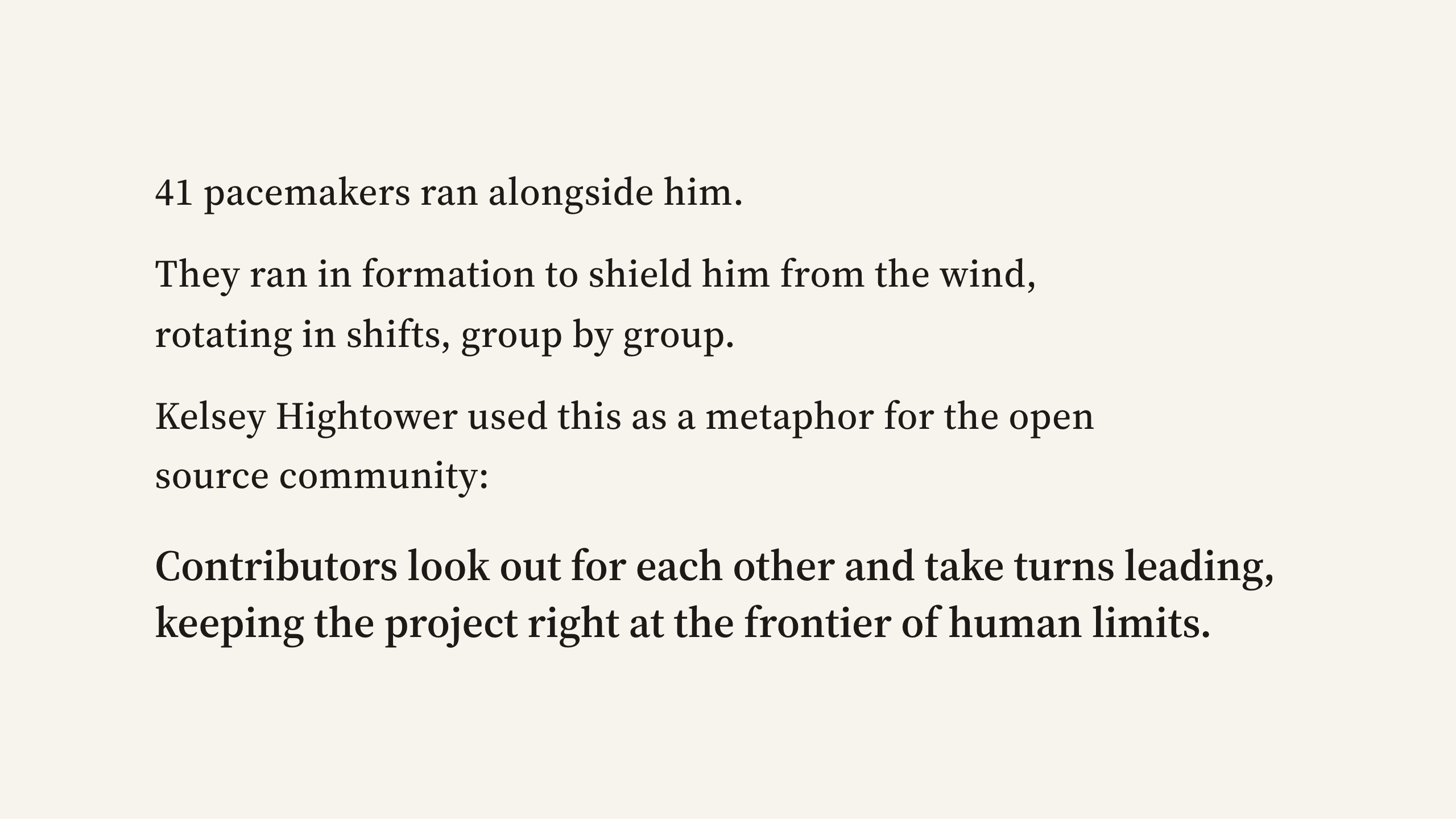
Kelsey Hightower, a well-known open-source evangelist, used that scene as a metaphor for the open-source community: contributors come and go, look out for one another, and take turns leading so the project keeps moving forward. For a long time, many open-source infrastructure projects have sat right at the frontier of human engineering and computer science, pushing against the limits of what we can build. I have always loved that analogy.
2. Human Frontiers and a Privilege That Once Belonged to Software
Personally, I have a simple appreciation for human civilization pushing things to their limits, and for the serendipitous branches along the way that leave behind extraordinary artifacts. It is a very basic preference: we enjoy wandering through museums, hunting down the best local street food whenever we land in a new city, and exploring every kind of music and art.
Those are precious relics left by centuries of history. Yet if your background and timing happen to line up so you can actually take part in pushing something toward a human frontier, that is an unforgettable feeling. I believe that is the quiet, often unspoken motivation behind why so many people want to contribute to open source.
In the past, I often gave talks about open source, hoping to introduce younger people and newcomers to what it is, how to join, and why it feels so exciting.
One point I kept coming back to was this: open source used to be a rare privilege almost unique to software engineering and computer science. You did not need expensive means of production. Especially in infrastructure, open source was the norm. You could take the coolest thing you built (sometimes while a company was paying you to build it) and give it away freely so others could stand on your shoulders and push it one step further, with no gatekeeping at all.
Very few fields enjoy that kind of openness: perhaps public health, and parts of scientific research that do not touch national security. It almost felt like a bug, too good to be true. If a young person had even the slightest interest in coding, I always told them they had to experience open source.
Before GenAI, coding felt like magic to me, and open-source communities felt like Hogwarts. Whether you were a kid who had never had a coding class or a Master of Laws (an LL.M., if you like) who had never been formally taught to code, you could still walk into an open-source project at the bleeding edge, start from zero, and find a bearded veteran patiently teaching you along the way.
3. From a Math Major Learning to Code to C. L. F. A. H. in 2021
That is literally how I got here.
I studied mathematics in college and did not know how to program. I even failed my undergraduate C programming exam once. It took five or six years of working before I realized what I truly loved: build things with magic. That feedback loop was deeply addictive (perhaps partly thanks to ADHD).
A few years later, I realized that beyond building things, I also loved helping others do the same. Whenever I could share how I built something, I felt energized enough to stay up all night crafting a demo I thought was cool, just to see someone smile when the underlying principle clicked. For years, my magic was open source, graph, and AI.
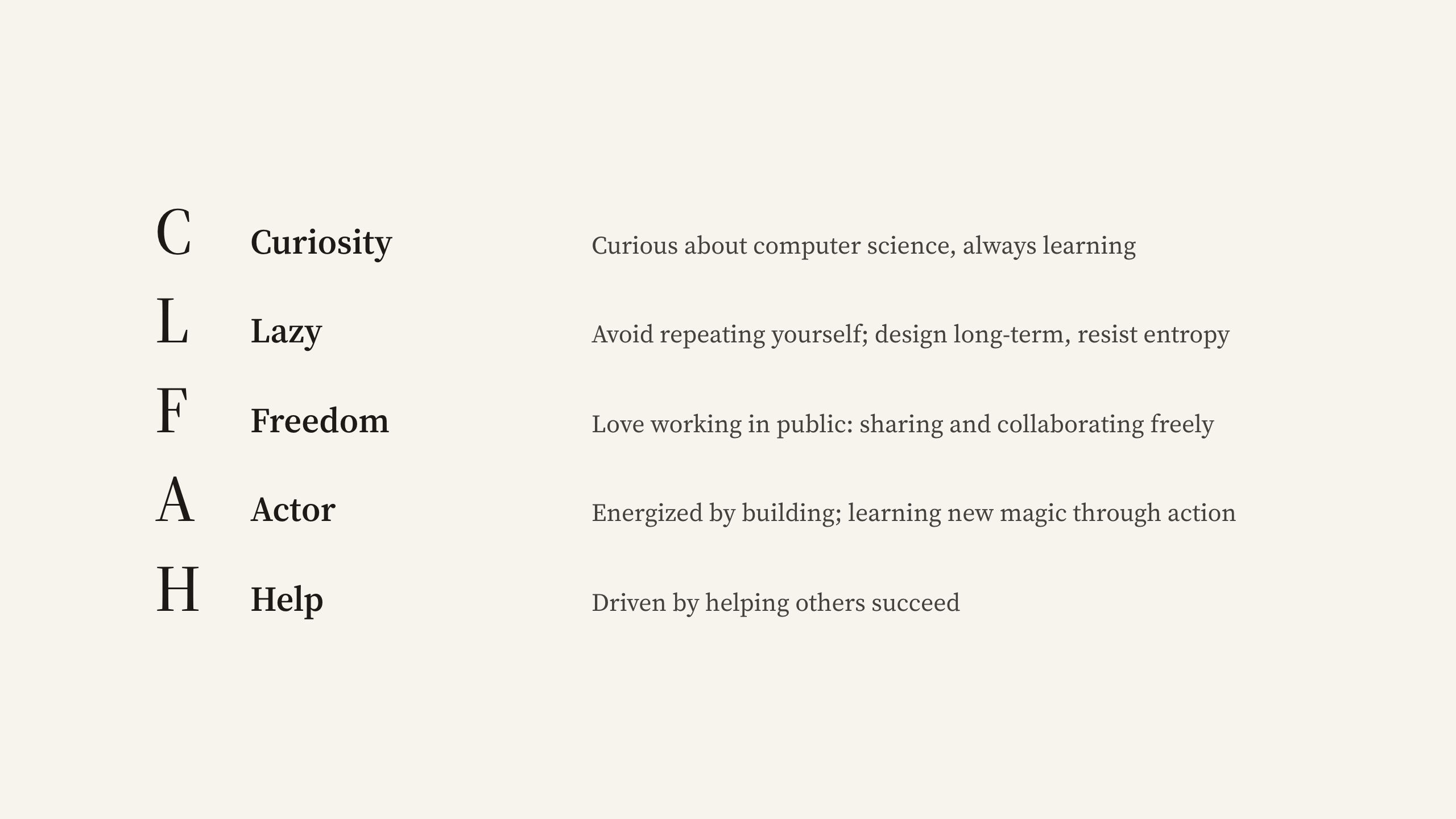
Back in 2021, at COSCon, I tried to summarize what kinds of people tend to gravitate toward open source and keep contributing. I coined a rather clunky acronym, C. L. F. A. H.:
- C for Curiosity: A genuine fascination with computer science and a desire to keep learning.
- L for Lazy: Refusing to repeat yourself, designing for the long term, and resisting entropy.
- F for Freedom: Loving work in public: sharing and collaborating without unnecessary barriers.
- A for Actor: Getting energized by building and creating, learning new magic through action.
- H for Help: Wanting other people to succeed, and being driven by it.
Looking back at those five words today, the world has shifted in a fascinating way.
4. The Age of Magic After GenAI: Turning Anything into a Reusable Spell
When I spoke about curiosity in 2021, I meant curiosity about computer science. After GenAI, the form of open source and open-source communities has transformed completely, even though the core spirit remains intact.
Today, people outside traditional software backgrounds are shipping remarkably successful open-source projects. The artifact is no longer necessarily a compiled binary. It spans life hacking, creative workflows, and artistic experiments.
Everyone knows the underlying reason: compared with the days when human labor had to specify and implement every step, we now have models that can close the loop and autonomously execute complex work. In a very real sense, intelligence is (almost) free.
That shift brings new challenges too (PR review in open-source projects has become a massive burden), which I will not go into here. Instead, let me share a personal before-and-after.
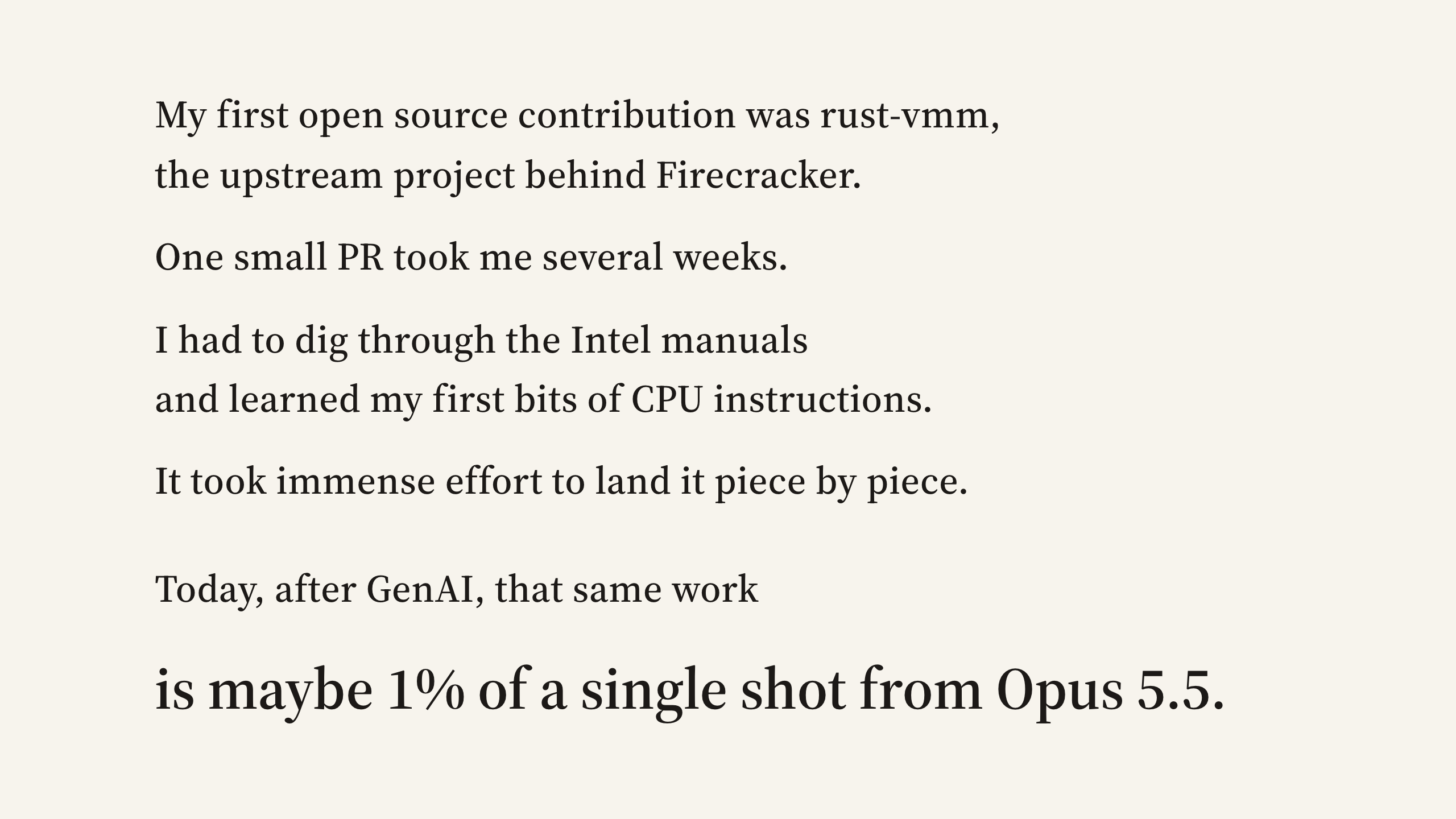
My very first open-source contribution was to rust-vmm, the upstream project behind Firecracker (which has become popular all over again thanks to AI sandboxes). A single small PR took me several weeks. I had to dig through Intel manuals I had never opened before, learn my first bits of CPU instruction semantics, and grind through every detail to get it merged.
Today, with models like Opus 5.5 leaping forward yet again, that entire multi-week effort might be 1% of a single prompt, and the model can often do it better.
So here is where we are: anything that can be expressed formally can now be packaged as a reusable spell and distributed widely. Capabilities that used to be painfully scarce have become cheap and abundant, while general yet sophisticated spells are steadily being absorbed into the common sense of next-generation foundation models.
As a fairly optimistic person, I see something deeply encouraging in this. What used to be a privilege reserved for people who happened to enjoy coding (the joy of building, standing on the shoulders of giants, and collaborating in public) now extends into every corner of work and daily life under GenAI’s new world parameters. I call this the Age of Magic.
Highly polished artistic workflows can become reusable skills or lightweight services. Deep industrial and creative know-how that once belonged exclusively to seasoned veterans can now be captured and shared. Sometimes, simply articulating an intent or a pain point, combined with meta know-how or a strong harness, allows a system to explore and build unknown unknowns you did not even realize you needed. Everything is becoming accessible to everyone.
When open source meets generative AI, open source becomes the norm of knowledge sharing and collaboration across all domains. Someone only needs to understand what open source means; an agent can help them register a GitHub account (perhaps with a handle even plainer than the ones we picked when we first signed up), handle the entire git workflow, and publish whatever cool discovery they made to the world.
So C. L. F. A. H. still holds, with one small update. Curiosity is no longer limited to computer science; it is curiosity about the entire world. Agency is no longer limited to writing code; it reaches every part of life and work. I feel genuinely lucky to live in this age of magic.
5. Nowledge Labs and Nowledge Mem: Knowledge Without Barriers
Bringing this back to what our team is building: my core drive has always been build things and help others do the same.
It reminds me of when I first started using email in middle school. Back then, Yahoo Mail gave you 6 MB and Hotmail gave you 2 MB. There was even a prank attack where people flooded your inbox until it overflowed, so everyone constantly had to archive old emails.
Then one day, Google launched Gmail with 1 GB of free storage. I immediately resonated with Google’s mission to make information universally accessible and free-flowing. What impressed me even more was how they made it work: through a sound business model and unconventional engineering (rethinking even server hardware from first principles), they made jumping from a few megabytes to 1 GB commercially viable so everyone could enjoy the internet without friction.
Fast-forward to 2023. The earliest signs of the age of magic were starting to show. Some outputs still felt a little creepy, yet the potential was unmistakable. Around that time I spent a lot of energy working on GraphRAG in the open-source community (and was fortunate to coin the term and build the first open-source implementation; the first definition is in a public workshop I gave in the LlamaIndex community).
As the world shifted from a pre-magic era into the age of magic (like a major version upgrade re-tuning the parameters of reality), I asked myself what I wanted to build. After spending an entire night talking it through with GPT-4, it clicked: I wanted to build infrastructure that lets people access the knowledge they need effortlessly, anytime and anywhere.
Previously, without cheap, abundant intelligence and multimodal processing, vast amounts of hard-earned knowledge stayed trapped inside the heads of experienced practitioners. They simply could not transfer that context across time zones, languages, and years. Today, that barrier is finally falling.
At the same time, my work on GraphRAG and knowledge graphs taught me something very concrete: domain-specific experience is deeply polymorphic. By its very nature, it cannot simply be swallowed whole by a general-purpose foundation model.
With that conviction, I started Nowledge Labs, originally intending to build a service called Nowledge. Once we began building it, however, we ran straight into a deeper, more urgent bottleneck: memory for human-AI collaboration. Nobody had solved it properly yet, and at the time it felt like no one understood how to build it better than we did. So we built Nowledge Mem first.
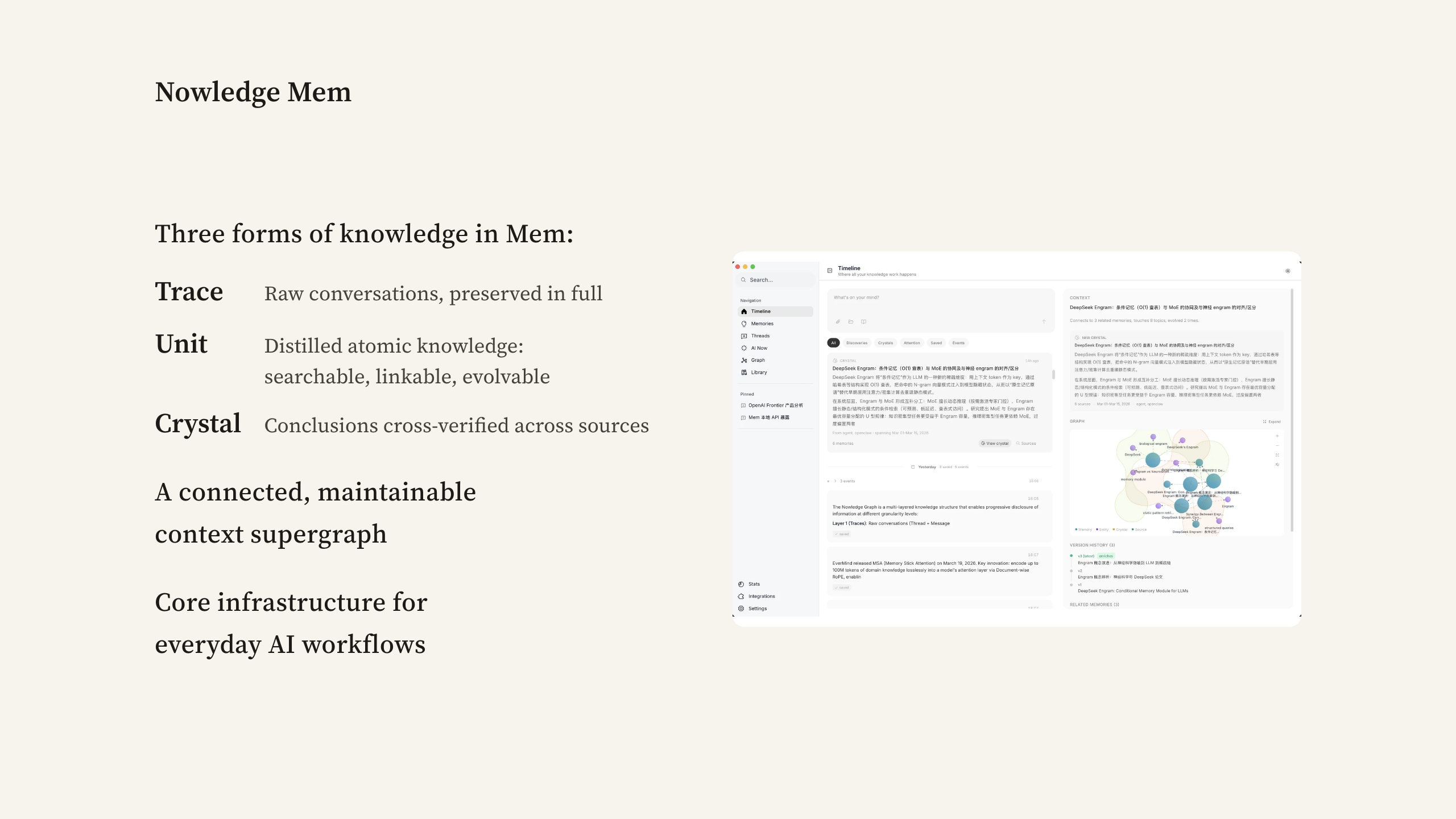
Inside Nowledge Mem, we build a connection-oriented, maintainable context supergraph that organizes context across distinct layers, from raw conversations (Trace) and distilled atomic knowledge (Unit) to cross-verified conclusions (Crystal). We do a lot of unglamorous plumbing underneath so that everyday collaboration between humans and AI gets a touch of quiet magic.
6. Nowledge Bridge and the Organizational Context Layer
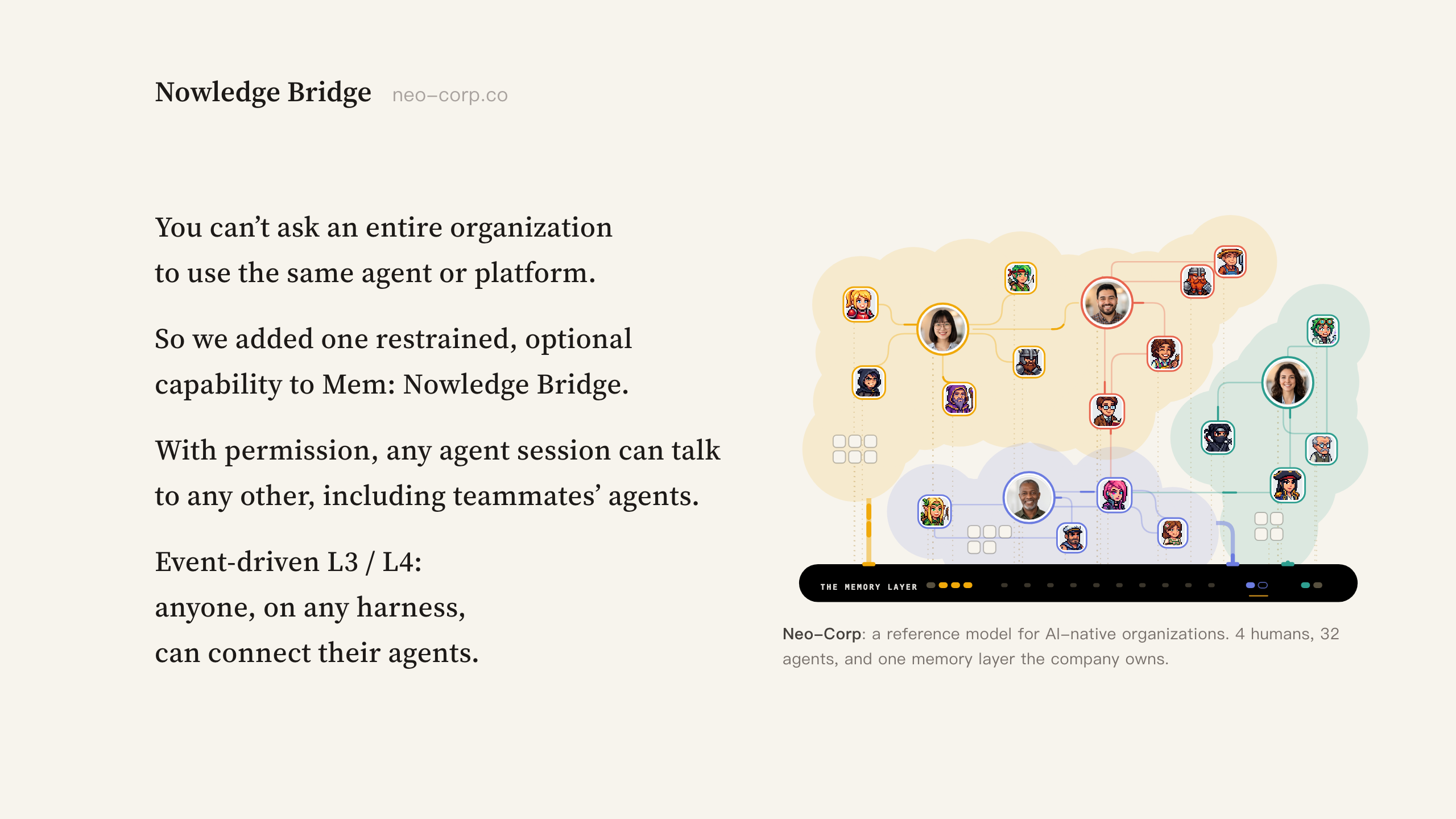
In the community, especially among early-adopter developers in China, we keep seeing people run multiple AI tools and agents side by side alongside Nowledge Mem. Naturally, when people sketch diagrams of their workflows, Mem ends up right in the middle.
That is not because Mem wants to be the star of the show. Quite the opposite: we want Mem to feel invisible, quietly doing its job in the background. It ends up in the middle simply because it connects to everything else.
Following that natural topology, we are introducing a restrained new capability we have not formally announced yet: Nowledge Bridge. With user permission, any agent session can communicate bidirectionally with any other session, whether it is in another tool of your own or belongs to a teammate’s agent. Using it internally has already unlocked surprising new ways of working together.
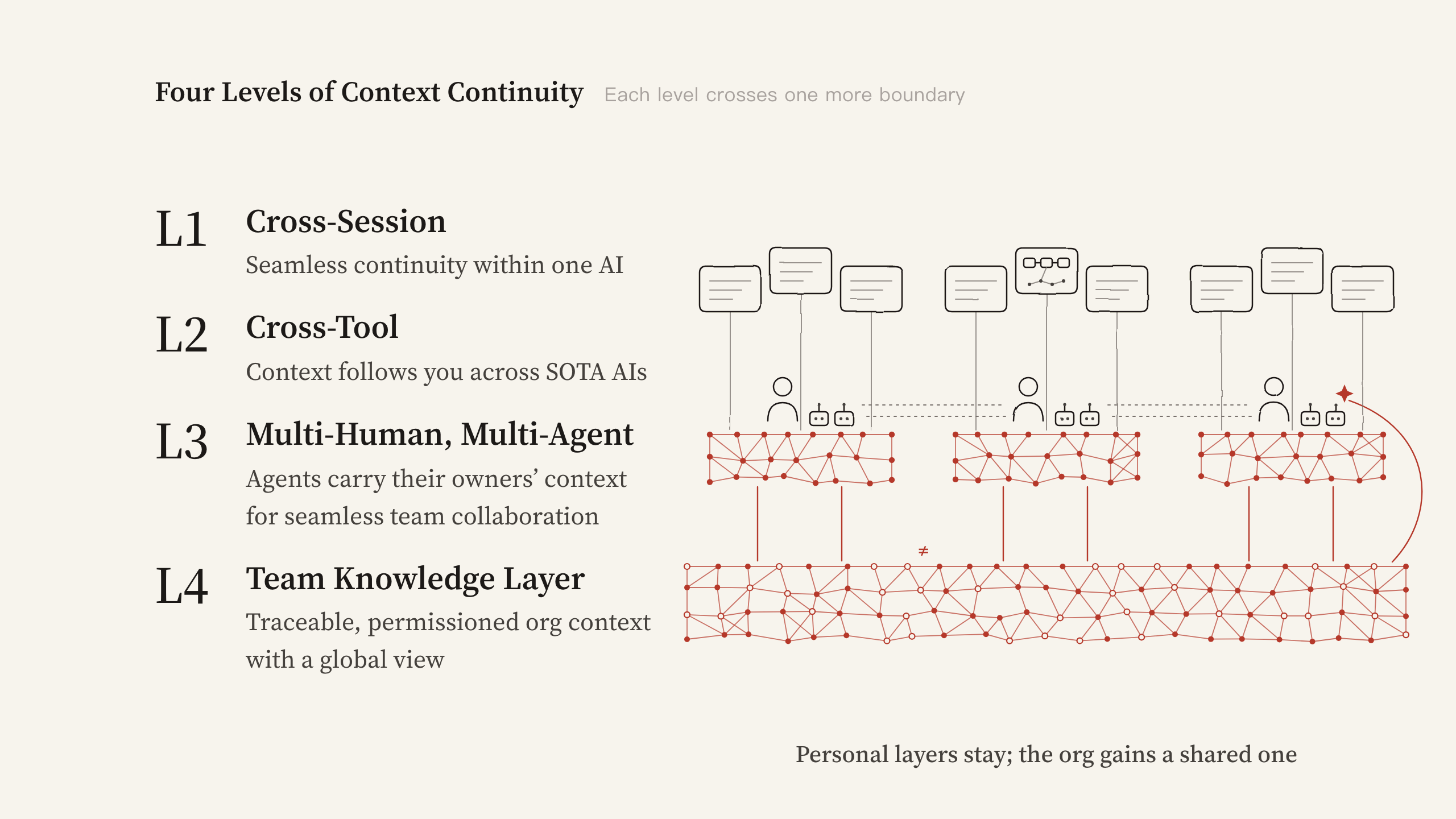
That leads directly into what we have poured most of our energy into over the past six months: the Context Layer for Organization.
We published a manifesto, and at neo-corp.co we sketched our reference paradigm for an AI-native organization: how context should flow across multiple humans, fleets of agents, and team communication channels.
We defined four levels of context continuity (L1 through L4): staying continuous across sessions in a single AI (L1), carrying personal context across tools (L2), collaborating across multiple humans and agents (L3), and finally growing a traceable, permissioned organizational knowledge layer with a global view (L4).
Even at L3, we experienced real aha moments ourselves. My co-founder was previously the top contributor to TiDB, while my background is in upper-layer knowledge systems. When we built the Cloud version of Mem together and put our respective agents, each loaded with its owner’s deep personal context and domain knowledge, into the same group to push work forward, the result felt genuinely magical.
Another major problem we are tackling is organizational amnesia.
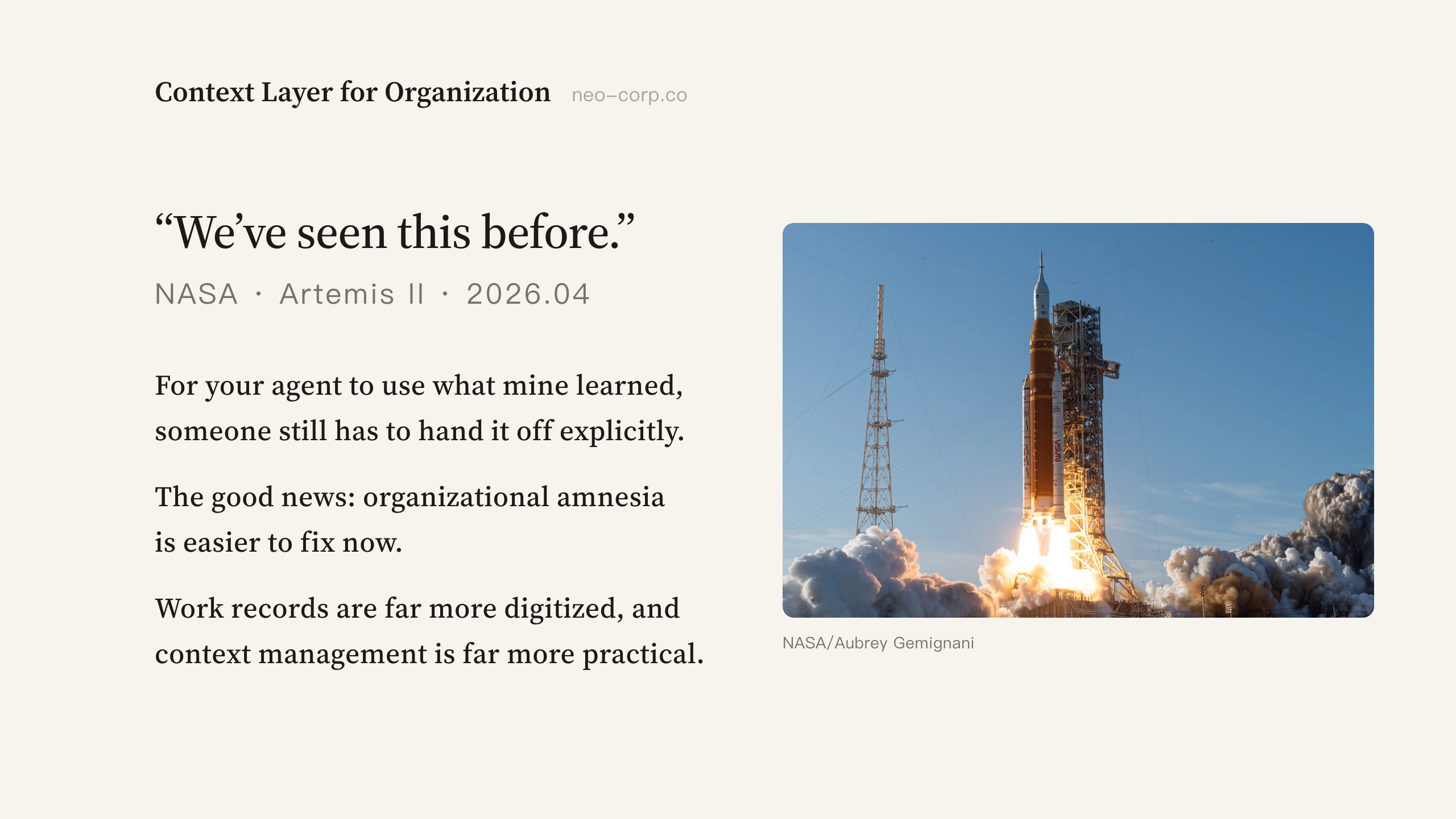
NASA’s Artemis II, the return to the Moon, offers a ready example. In February this year, the wet dress rehearsal was terminated a little over five minutes before the end of the countdown because of a liquid hydrogen leak, and the February launch window was lost with it. The same kind of leak had already shown up on the previous mission, Artemis I.
Everyone recognizes this pattern. Whether between you and your own agents or across a whole team, re-learning lessons that were already paid for happens almost daily. That is organizational amnesia, and our work aims to address it systematically.
There is a counterintuitive piece of good news here, too. Because modern work is now heavily involved with AI, AI naturally compels us to digitize workflows that used to feel awkward or inconvenient to record. In the past, even when companies bought digital tools, people worked around them whenever they added friction. With AI in the loop, work gets captured digitally at a far higher density than ever before, which makes organizational amnesia far more solvable than at any point in history.
7. Three Open-Source Projects: HawDB, Con, and Ducter
To wrap up, I want to share three open-source projects we have been building.
1. HawDB: An Embedded Database Built for Context Systems
HawDB (hawdb.ai) is an open-source database we decided to build from scratch to power our context infrastructure.
Under memory and context workloads, stitching together existing databases breaks down quickly. We used to maintain three separate engines simultaneously: SQLite, a vector database, and a graph database. Consider something as basic as a memory edit: updating a single fact often cascades across linked nodes and indexes. Maintaining consistency at the data layer requires a single transaction, and anyone who has dealt with cross-database transactions knows how painful that is.
Agent workloads also introduce native structural needs, such as storing sessions with branching and forking, and efficiently indexing session trajectories. So we unified graph (data and algorithms), rows, full-text search, vector search, and native session storage inside a single embedded Rust engine. Part of it is already open source, led by our CTO. He was the top contributor to TiDB and still ranked first three months after leaving. If you are building any system that stores context, come take a look at HawDB.
2. Con: A Restrained Terminal for Veteran Terminal Users
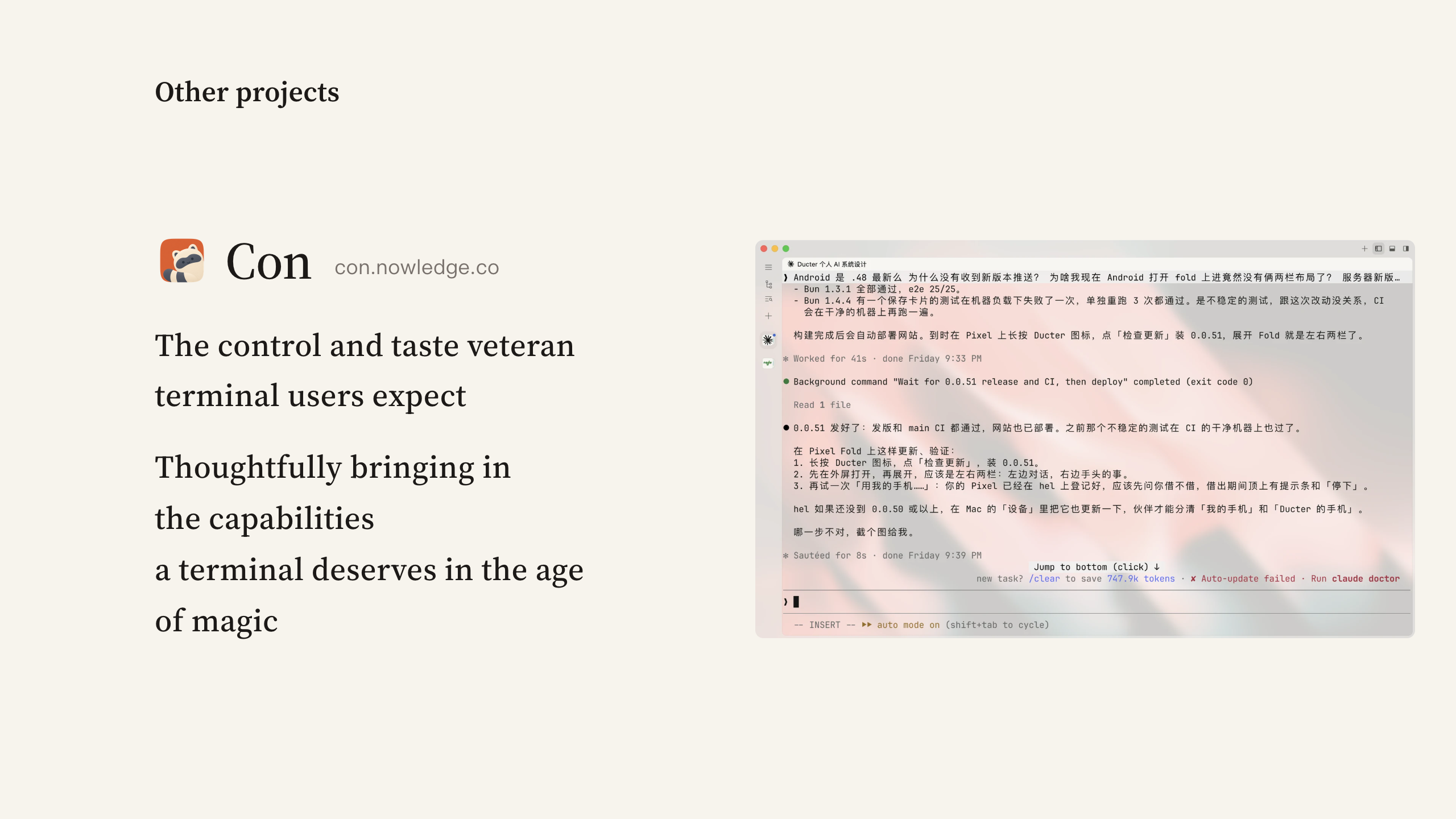
Con (con.nowledge.co) is a personal open-source project born from a veteran terminal user’s taste: bringing the capabilities a terminal deserves in the age of magic, while staying disciplined and restrained.
It started quite early, before Warp was open-sourced and back when models barely understood GPUI. Since then we have polished it extensively, and it has attracted a wonderful group of contributors.
3. Ducter: A Personal AI Workbench Built Over a Weekend in Japan
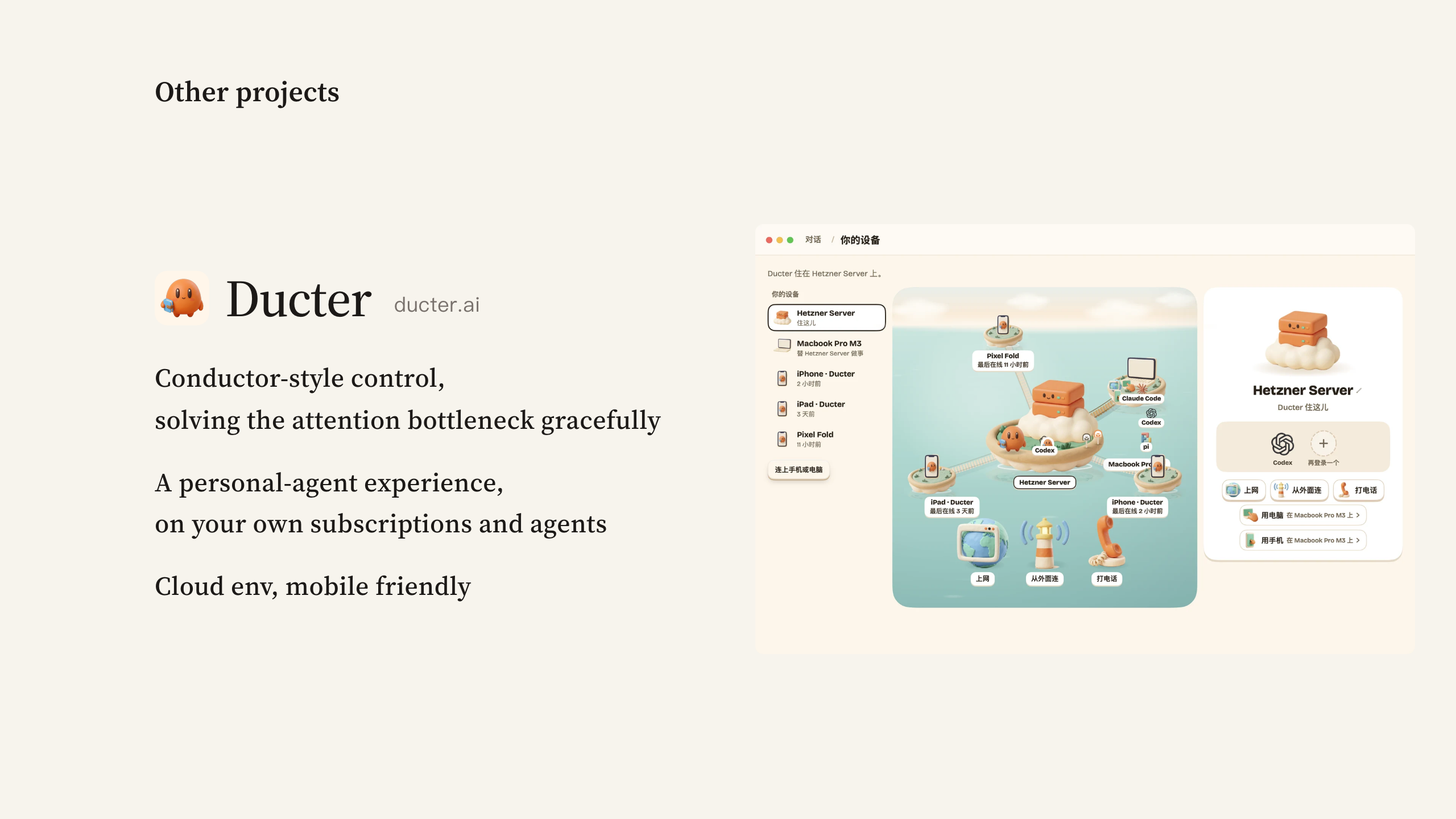
The final project is Ducter (ducter.ai). Last week I traveled to Japan for work, skipped sightseeing for the entire weekend, and wrote it from my Airbnb.
I had been a heavy user of Conductor and similar orchestration tools, and at the time Conductor had announced it was shutting down after being acquired by Meta (it later announced on November 13 that it was back). At the same time, I had hit two real bottlenecks: first, a human brain simply cannot track seven or eight parallel agent sessions at once; second, I needed a way to manage long-loop tasks running in the cloud from my phone, iPad, or foldable without being tethered to my laptop.
So I built Ducter. It combines fine-grained, Conductor-style task control with the proactivity of a personal agent: with your permission it can handle Gmail, place phone calls, or even do phone use, all running on your own harness and model subscriptions. It has become my new everyday way of working with AI.
Closing
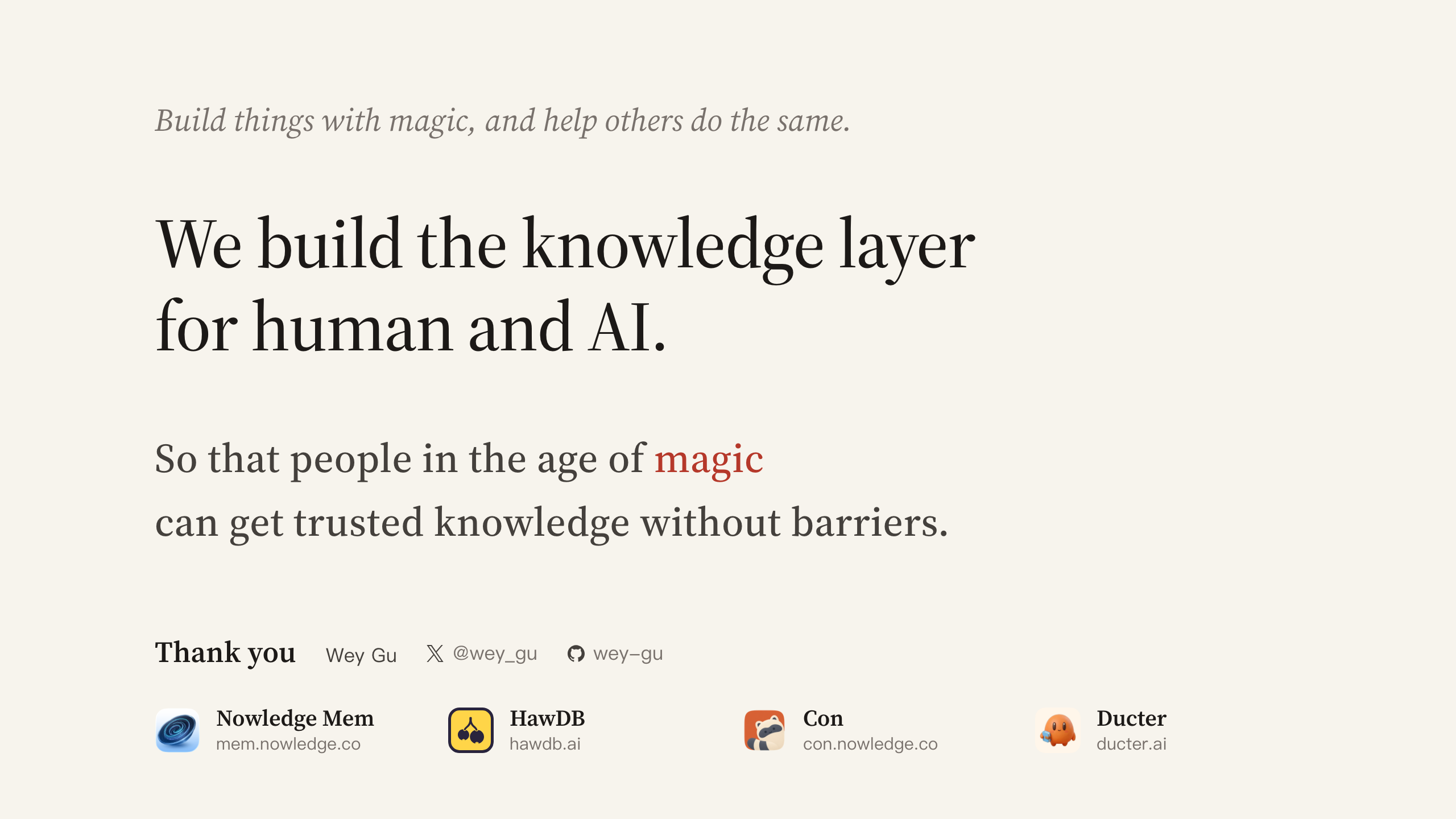
Looking back, what drew me into this world was Build things with magic, and help others do the same. Today, what we are building together is the knowledge layer for human and AI, so that people in the age of magic can get trusted knowledge without barriers.
Thank you!